


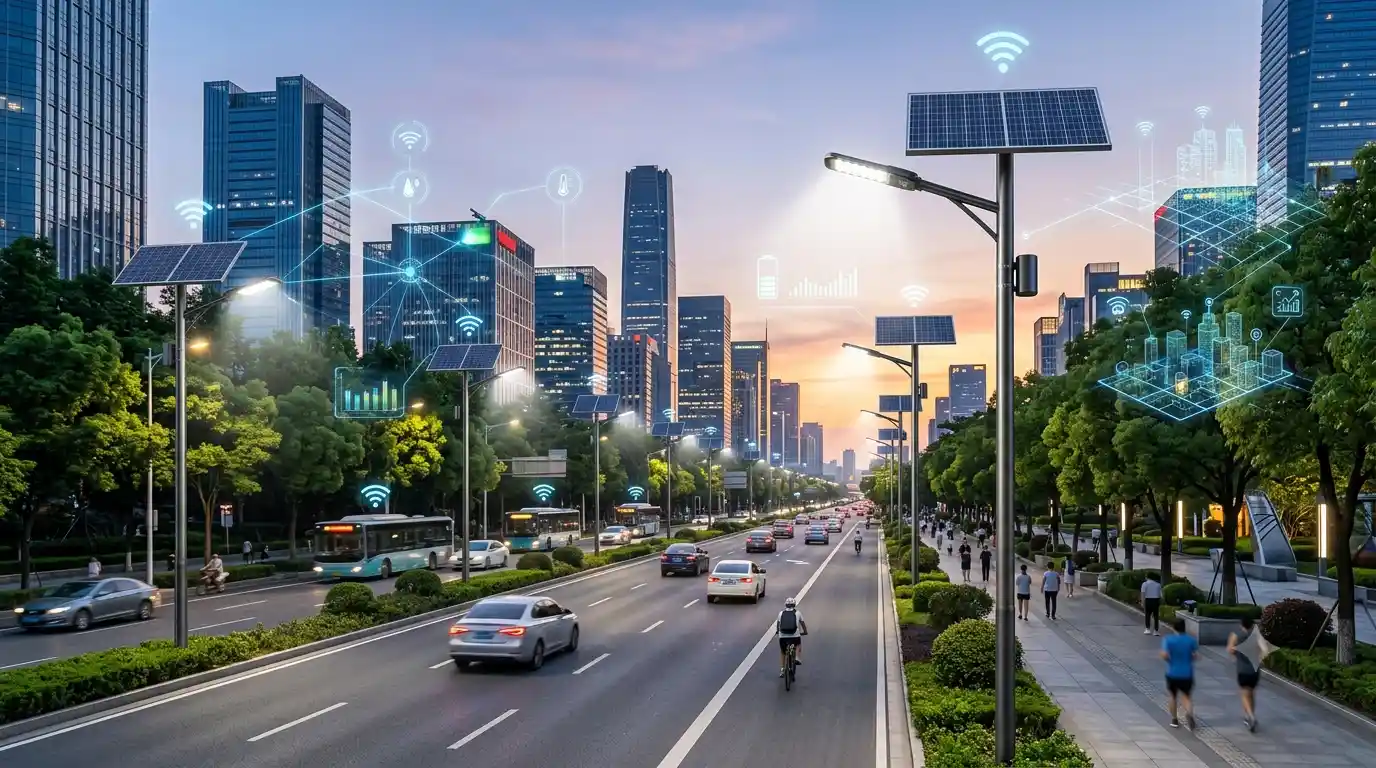
Benefits of Smart Solar Street Lights for Smart Cities
As cities move toward digital transformation and sustainable infrastructure, smart solar street lights for smart cities are becoming a core component of modern urban development. These advanced lighting systems combine solar energy, LED technology, battery storage, and IoT-based smart controls to deliver efficient, reliable, and eco-friendly street lighting.
With growing concerns around energy consumption, carbon emissions, and public safety, smart solar street lighting systems provide a scalable and cost-effective solution for municipalities, industries, and urban planners.
What Are Smart Solar Street Lights?
Smart solar street lights are self-sustaining lighting systems powered by solar photovoltaic (PV) panels. Unlike traditional grid-connected street lights, they generate and store their own electricity using solar energy.
These intelligent lighting systems often include advanced features such as:
- Motion sensors for adaptive brightness
- Remote monitoring via IoT platforms
- Automatic dimming and brightness control
- Energy management systems
- Fault detection and real-time alerts
- Smart scheduling and automation
Key Benefits of Smart Solar Street Lights
One of the biggest advantages of smart solar street lights is zero dependency on grid electricity. They operate entirely on renewable solar power, significantly reducing energy bills for municipalities. Over time, cities benefit from reduced electricity consumption, lower operational expenses, and improved energy efficiency in public infrastructure — making them a cost-effective solution for long-term urban lighting projects.
- Zero electricity bills
- Reduced operational expenses
- Improved energy efficiency
Smart solar street lighting helps reduce the carbon footprint of cities by replacing conventional fossil-fuel-based electricity with clean and renewable solar energy. This makes solar lighting a key enabler of green smart city development.
- Reduced GHG emissions
- Lower fossil fuel dependency
- Supports sustainability goals
Modern smart solar street lights use high-efficiency LED luminaires with long operational lifespans. Combined with smart diagnostics, maintenance requirements are significantly reduced, resulting in lower maintenance overhead for municipal authorities.
- Longer LED lifespan
- Remote fault detection
- Predictive maintenance
- Reduced inspection costs
Proper street lighting is essential for public safety. Smart solar street lights ensure continuous and reliable illumination, even during power outages. Motion-sensor-based brightness enhancement improves visibility and reduces crime risk in poorly lit zones.
- Motion-triggered brightness
- Better visibility
- Reduced crime risk
- Safer roads
Unlike grid-connected lighting systems, solar street lights operate independently. This ensures uninterrupted lighting during power failures, natural disasters, and grid instability — making them highly suitable for critical infrastructure and emergency-prone areas.
- Independent from grid
- Works during outages
- Disaster-ready
Modern smart solar street lighting systems can be integrated with IoT-based centralized control platforms, enabling real-time monitoring and optimization. Municipalities can track energy generation, monitor battery health, detect faults instantly, and control brightness remotely.
- Real-time energy tracking
- Battery health monitoring
- Remote brightness control
- Instant fault alerts
Smart solar street lights are easy to deploy since they do not require underground wiring or grid connectivity. This reduces installation time, cost, and infrastructure disruption — ideal for rapid smart city expansion on highways, campuses, parks, and industrial areas.
- No underground wiring
- Faster deployment
- Lower installation cost
Smart solar lighting systems are highly scalable and can be upgraded with additional smart technologies. This makes them a future-ready smart city investment that grows alongside evolving urban requirements.
- CCTV integration ready
- Environmental sensors
- Traffic monitoring
- Smart communication modules
Applications of Smart Solar Street Lights
Deployed widely across public, industrial, and government infrastructure across India.
Economic Benefits for Municipalities
Although initial installation costs may be higher than conventional lighting, smart solar street lights offer significant long-term financial benefits. This results in a lower total cost of ownership (TCO) over time.
- Zero electricity bills
- Reduced maintenance expenses
- Long operational lifespan
- Lower infrastructure dependency
- Government renewable energy incentives
The Future of Smart Urban Lighting
As cities adopt IoT, AI, and renewable energy solutions, smart solar street lighting systems will play a central role in future urban infrastructure. Governments worldwide are increasingly investing in smart solar lighting to build sustainable, connected, and energy-efficient cities.
Upcoming integration trends shaping the sector:
Conclusion
Smart solar street lights for smart cities represent the perfect combination of sustainability, technology, and cost efficiency. They reduce energy consumption, lower operational costs, improve public safety, and support environmental sustainability goals.
For municipalities, developers, and infrastructure planners, adopting smart solar street lighting is a strategic step toward building future-ready smart cities.
Explore SAILITE Solar Products